Acquisition Opportunity
The most efficient data centerlives in your water heater
Compute immersed inside the tank reuses nearly 100% of its heat: near-zero cooling cost, PUE approaching 1.0. Patented, built, tested, and backed by its inventors. Granted in Europe and the US, allowed in Canada, pending in Australia.
Earliest priority (2019) predates every funded competitor.
Granted in Europe (classic + Unitary) and the US, allowed in Canada, pending in Australia.
Built, CSA certified, pressure tested to 300 PSI, operating in the field. Not a paper patent.
Two decades of runway on the anchor family, with divisional options still open.
[ The Problem ]
Two sides of the economy pay for the same heat.
Compute is hitting a power wall
Data center electricity is set to more than double by 2030 (IEA); projected US demand of ~74 GW by 2028 faces a ~49 GW power shortfall. Energy, not chips, is the binding constraint on AI.
Half the energy goes to unwanted heat
Roughly half the energy a conventional data center consumes does nothing but move heat somewhere it is not wanted. The scarce resources are energy and sites, and everyone is fighting for the same ones.
Homes pay to make the same heat on purpose
Water heating is the second-largest energy expense in the home (18%, US DOE). Roughly 40M tank heaters are installed in North America alone: 180+ GW of connected, permitted power, replaced by the millions every year. At full utilization that is ~1,570 TWh per year, over 1.5x the IEA's projected 2030 global data center demand.
Key Message
The problem is access to energy and sites. The water heater is both: pre-powered, pre-sited, in nearly every building.
[ The Solution ]
A water heater and a computer that keep each other alive.
[ The Design ]
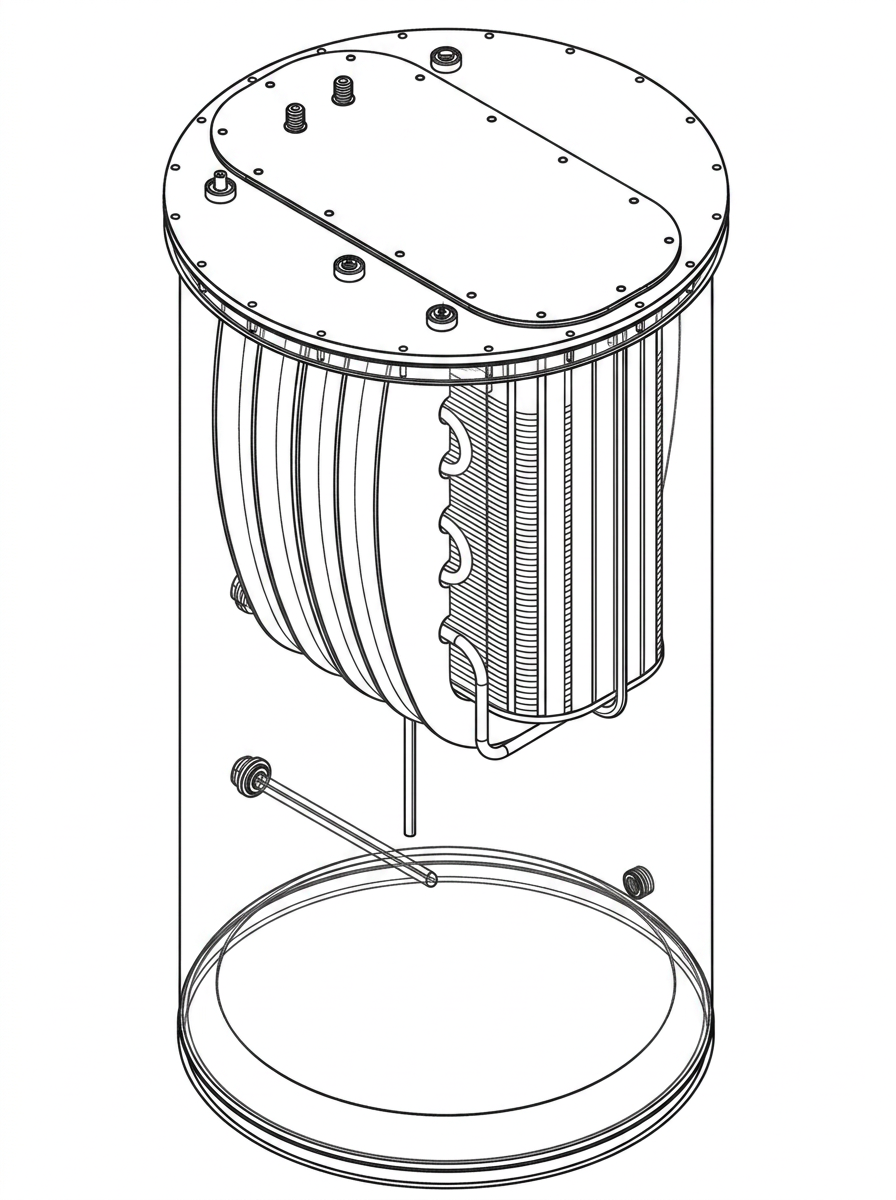
A sealed heat-exchanger tank, filled with dielectric fluid, mounted directly into the top of a standard water tank. The computing device is immersed in that fluid. Compute heat warms the water; water cools the compute. The product is AI inference anywhere: local inference, distributed learning, distributed storage.
[ Why It Wins ]
No pump and no moving parts in the thermal loop, so nothing to fail in a decade of unattended service. Immersion inside the water volume is the shortest path from silicon to hot water. Top access door: swap compute in minutes without touching the plumbing.
[ The Numbers ]
Effective cooling PUE approaches 1.0, saving roughly 4 MWh per unit per year (company data). In buyer terms: lower cost of operation, no cooling capex.
[ Built and Operating ]
TRL 8: four third-generation units running at a Canadian pilot site. CSA certified, pressure tested to 300 PSI, vendor-agnostic servers, fleet control software included.
Key Message
A buyer inherits finished engineering, not a science project.
[ The Market ]
The market has arrived.
Superheat (US)
H1C compute water heater won a CES 2026 Innovation Award; pre-orders opened July 2026 at $2,999. Pitch: 'the heater that pays you back.'
Watter (US)
$5M seed led by Hunt Innovative Technologies. Sells 'net zero compute' with hot water as the byproduct. Heata, Qarnot, and Thermify run the same play in Europe.
Span + Nvidia (US)
XFRA puts GPU nodes on homes behind smart panels, piloting with a top-5 US homebuilder. Residential edge compute is now a mainstream strategy.
Global water heater market, to ~$50B by 2031; tank type is 83% of NA, 67% of EU.
Edge computing, the infrastructure for AI inference anywhere; growing 28-35% annually.
Waste-heat reuse Germany already mandates for new data centers, 2026-2028.
[ The Gap ]
The funded category is built on external-mount architectures. No incumbent holds rights to the in-tank immersed architecture this portfolio protects: the shortest thermal path, with no pump to fail.
[ The IP ]
Own the architecture.
Earliest priority, efficiency high ground
Earliest priority (2019) predates every funded competitor. The claims cover the in-tank immersed configuration, the design rivals would prefer to build; the funded category runs on less efficient external mounts. Five patent families cover the unit, the network layer (AI load control), and operations.
Steerable by its next owner
Options to pursue additional filings within existing families and expand the portfolio based on invention disclosures. Invention disclosures create an IP roadmap of what to file next.
More than patents
So does the team: inventor-led handover in weeks, integration consulting beyond a year, and IP roadmap guidance. Certified hardware, enclosure design, control software, and field data convey. Structures: full IP sale, exclusive license, license + collaboration, or hybrid.
[ Draft: patent register update in progress; details to be confirmed against the revised list ]
Every water heater is a data center waiting for permission.
Additional materials available under NDA.
We anticipate a transaction closing in Q4 2026.
All interested parties are encouraged to reach out as soon as possible to discuss expectations and deal structure.
Inventor handover, integration consulting, and IP roadmap support convey with the transaction.
Andy Godsey · The Inventor Playbook · andy@theinventorplaybook.com